
The sustainable transition is a crucial challenge, and Open Power Grids (OPG) is actively following the ongoing changes in the energy sector.
Farewell to SF6 Gas: Making Room for Innovative Solutions
On February 20, 2024, Regulation (EU) 2024/573 of the European Parliament and of the Council of February 7, 2024, on fluorinated greenhouse gases was published in the Official Journal of the European Union (Series L).
The new Regulation (EU) 2024/573 came into force on March 11, 2024, and pursues the objective of progressively eliminating the use of fluorinated gases with a high climate impact by encouraging the use of natural and low climate impact refrigerant gases.
This regulation applies to:
- Fluorinated greenhouse gases listed in Annexes I (HFCs, PFCs and other perfluorinated compounds and fluorinated nitriles), II (unsaturated hydro(chlorochlorine)fluorocarbons and other fluorinated substances) and III (ethers, ketones and other fluorinated compounds), alone or as mixtures containing such substances;
- Products and equipment, and parts thereof, containing fluorinated gases.
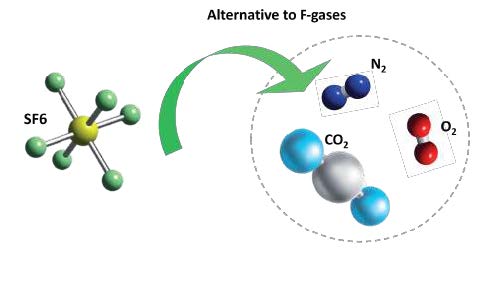
Since sulfur hexafluoride (SF ) is a potent greenhouse gas whose climate impact is about 22,800 times greater than that of carbon dioxide and its residence time in the atmosphere is about 3,200 years, European legislation mandates a gradual and progressive decommissioning of current technical solutions in favor of new generation insulating gases according to the following timing:
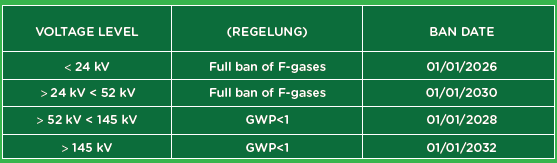
The implementation of the European regulation represents a fundamental step towards reducing the environmental impact of electricity grids, which must be addressed by all players in the supply chain without compromising the efficiency and safety of the grid.
The advantages of new insulating gases
Emission reduction
New gases, such as those based on nitrogen or mixtures of fluorinated gases with low GWP (Global Warming Potential), significantly reduce greenhouse gas emissions.
Improved performance
These gases offer superior performance in terms of safety and durability of devices.
Italian and European scenario
At the Italian level, due to different legislation in force between Italy and the rest of Europe, the Italian Electrotechnical Committee, responsible at the national level for technical standardization in the electrotechnical, electronic and telecommunications fields, with the direct participation – on behalf of the Italian State – in the corresponding European (CENELEC – Comité Européen de Normalisation Electrotechnique) and international (IEC International Electrotechnical Commission) standardization organizations has produced the CEI TR 17-148 Technical Report, which compares international and European regulations governing the sector with current Italian legislation in terms of pressure vessels.
At the European level, the institutional dialogue of the various stakeholders is still ongoing for clarification on some “concepts” present in the regulation. One of the most important one is such as that of “put in service”.
The definition of “put in service” is really important for DSOs and refers to the moment when an electrical
equipment with alternative insulation is made available for the first time by manufacturers to DSOs. This date is crucial for the purposes of the regulation, as it determines the applicability of the commissioning bans.
